
Plant Identifier by Picture
Upload a photo. Get the plant name, scientific name, and a care schedule in seconds — no account required.
Upload a clear photo of the leaves or flowers
JPG, PNG or WebP · Max 4 MB · 1 free identification per day
- Focus on leaves or flowers — avoid blurry or backlit shots
- One plant per photo works best
- Natural light gives the most accurate results
Get a more reliable plant identification
Photograph a leaf, flower, or other distinctive part of the plant in natural light. Avoid heavy shadows, filters, and busy backgrounds. If the confidence score is low, try a second photo from another angle rather than treating the first result as certain.
Start with a clear feature
Leaves and flowers usually provide more useful signals than a distant photo of the whole plant.
Use the result as a starting point
Compare the suggested name with visible traits before changing care, especially for uncommon plants or low-confidence matches.
Continue with care guidance
Once you have a likely match, explore our pothos care guide, snake plant care guide, or succulent care guide.
How plant identification works
Three steps from photo to plant name. No account, no signup, no wait.
Take or upload a photo
Photograph the leaves, flowers, or the whole plant. Natural light and a leaf close-up give the most accurate results.
AI analyzes 400,000+ species
PlantNet AI compares the image against a database of hundreds of thousands of labeled plant specimens from herbaria worldwide.
Get the name and care schedule
You receive the common name, scientific name, confidence score, and a baseline watering schedule. Download Olmi for the full care plan.
Works for every type of plant
Houseplants, garden plants, trees, succulents, wildflowers — the AI is trained on hundreds of thousands of species. If it grows, you can identify it.
Houseplants
Pothos, Monstera, Snake Plant, Fiddle Leaf Fig, and hundreds more.
Succulents & Cacti
Echeveria, Aloe, Haworthia, Crassula, Sedum, and more.
Outdoor plants
Garden flowers, shrubs, perennials, and ornamental plants.
Trees
Identify common and uncommon trees by their leaves or bark.
Wildflowers
Native and non-native wildflowers, including invasive species.
Herbs
Culinary and medicinal herbs, including lookalikes.
Know your plant. Never kill it again.
Once you know what you have, Olmi builds the care routine around it. Watering reminders, care history, disease diagnosis, and streaks that keep you consistent.
Download Olmi Free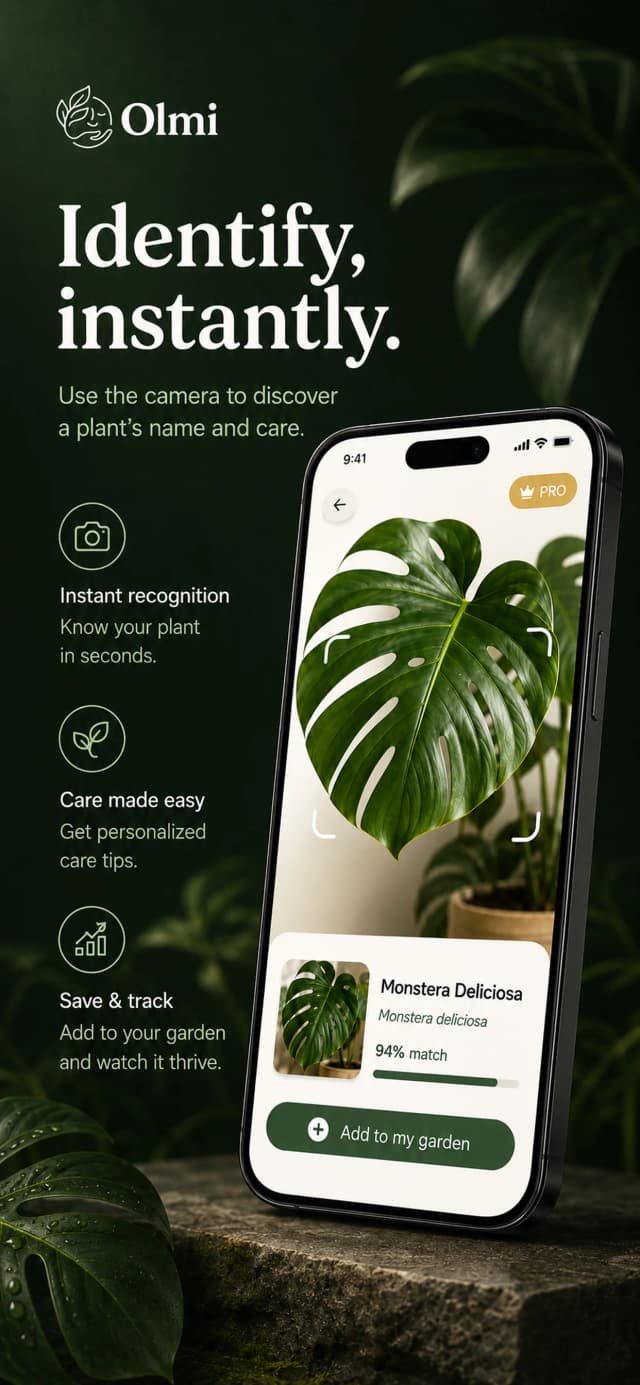
Frequently Asked Questions
Can I identify a plant from a photo for free?
Yes. This tool allows 1 free plant identification per day without creating an account. For unlimited identifications, download the Olmi app.
How accurate is the plant identifier?
The identifier uses PlantNet AI, trained on millions of plant images. Accuracy depends on photo quality — clear photos of leaves or flowers in good light give the best results. The confidence percentage tells you how certain the AI is.
What plants can it identify?
The AI can identify hundreds of thousands of plant species, including houseplants, garden plants, trees, shrubs, wildflowers, succulents, and cacti. It works for most plants found in North America, Europe, and beyond.
How is this different from Google Lens?
This tool is specialized for plants — it shows species confidence scores, common names, scientific names, and watering schedules. Google Lens is general-purpose. For a full experience including care reminders and history, use the Olmi app.
Can I identify a plant without any context or info?
Yes. Just upload a photo — no need to know anything about the plant beforehand. The AI analyzes leaf shape, color, texture, and structure to identify the species.
What happens after I identify a plant?
You get the plant name, scientific name, and a basic watering schedule. Download the Olmi app to save the plant to your collection, set up watering reminders, track care history, and get a full AI-generated care plan.
Does it work for rare or tropical plants?
The AI is trained on a broad plant database including many rare and tropical species. Results are more reliable for common species. If confidence is low, try a clearer photo or a different angle.